The Industrial Dilemma: Serial vs. Ethernet
Since its release by Modicon in 1979, Modbus has become the de facto standard for industrial communication. However, as factories move toward Industry 4.0, the choice between the classic Modbus RTU (Remote Terminal Unit) and the modern Modbus TCP/IP (Transmission Control Protocol) has significant implications for system latency, scalability, and cost.
While both protocols share the same application layer and data model (Registers and Coils), they reside on different physical layers and use different framing methods to ensure data integrity.
What is Modbus RTU?
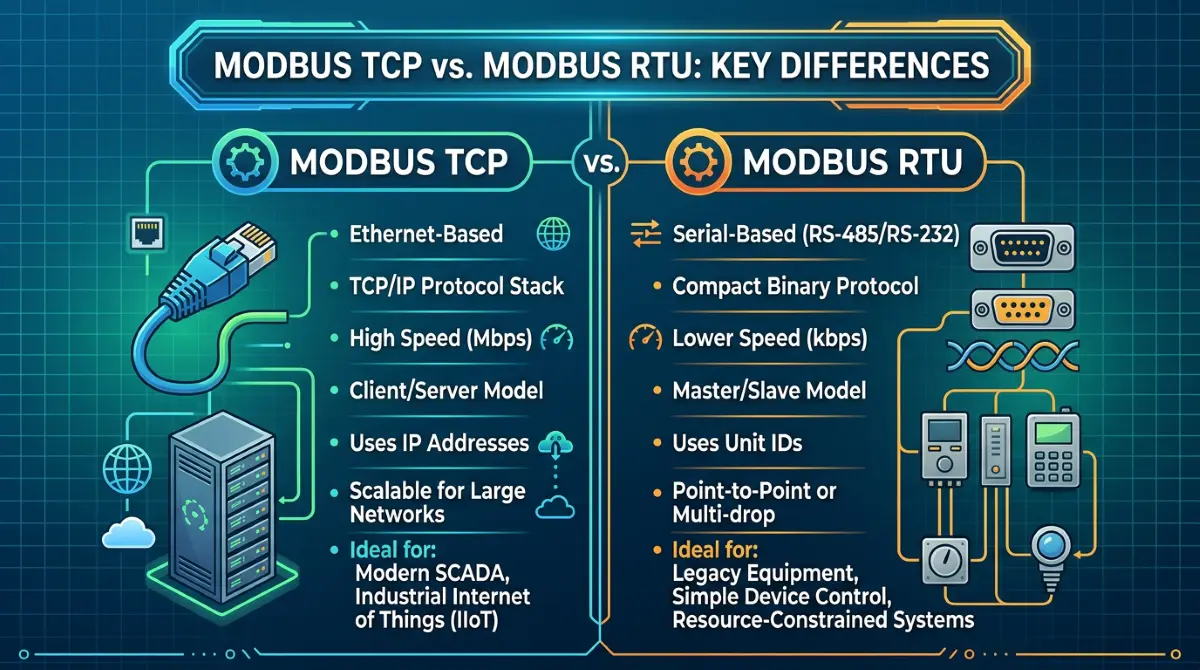
A serial communication protocol that transmits data in a compact, binary format. It typically operates over RS485 or RS232 physical layers, using a Master-Slave architecture. It is prized for its simplicity and reliability in electrically noisy environments.
What is Modbus TCP?
An adaptation of Modbus for Ethernet networks. It wraps the Modbus message inside a TCP/IP packet, using a Client-Server architecture (Port 502). It enables high-speed data transfer and integrates seamlessly with standard IT infrastructure and the cloud.
Data Frame Structure: PDU vs. ADU
The most profound technical difference lies in how the Protocol Data Unit (PDU)—the core of the Modbus message consisting of the Function Code and Data—is packaged for its environment. This package is known as the Application Data Unit (ADU).
Modbus RTU Frame (Binary Serial)
Modbus RTU relies on timing for frame separation (a silent interval of at least 3.5 character times). Because serial lines are prone to electromagnetic interference (EMI), it includes a robust error-checking mechanism.
- CRC (Cyclic Redundancy Check): A 16-bit mathematical checksum added to the end of every packet to ensure no bits were flipped during transmission.
Modbus TCP Frame (Ethernet)
Modbus TCP removes the Slave ID and CRC, replacing them with a 7-byte MBAP Header (Modbus Application Protocol). Since TCP/IP already handles error checking and packet retransmission at the lower networking layers, the Modbus CRC is redundant and thus omitted.
- Transaction Identifier: Used for pairing requests and responses in a multi-threaded environment.
- Unit Identifier: Replaces the Slave ID, primarily used when communicating with an Ethernet-to-Serial gateway.
Protocol Comparison Table
| Feature | Modbus RTU | Modbus TCP |
|---|---|---|
| Error Checking | 16-bit CRC | Handled by TCP/IP Link Layer |
| Addressing | Slave ID (1-247) | IP Address + Unit ID |
| Synchronization | Timing intervals (3.5 char) | MBAP Length Field |
Physical Layer: RS485 vs. Ethernet
The most visible difference for an engineer is the physical cabling and the networking hardware required. While Modbus RTU is built for legacy serial resilience, Modbus TCP leverages the massive infrastructure of modern IT networks.
Modbus RTU (Serial)
- Cabling: Shielded Twisted Pair (STP).
- Topology: Daisy Chain (Bus). Sensors are wired in a line.
- Distance: Up to 1,200 meters (4,000 ft) without repeaters.
- Hardware: RS485 transceivers, USB-to-RS485 converters.
Modbus TCP (Ethernet)
- Cabling: Cat5e / Cat6 Ethernet cables.
- Topology: Star Topology. Devices connect to a central Switch.
- Distance: 100 meters per segment (Unlimited via Fiber/WiFi).
- Hardware: Ethernet Switches, Routers, Gateways.
The Role of Modbus Gateways
Can they coexist? Yes. In modern factories, Modbus Gateways are used to convert Modbus RTU (Serial) into Modbus TCP (Ethernet). This allows a central SCADA system in the office to poll legacy RS485 sensors on the factory floor over the existing local area network (LAN).
Performance: Throughput & Latency
When choosing between RTU and TCP, the “speed” of the protocol is often the deciding factor. However, speed in industrial automation is measured in two ways: Bandwidth (how much data) and Latency (how fast a single request returns).
Modbus RTU: Serial Bottlenecks
RTU is limited by the Baud Rate of the serial line. While 115.2 kbps is possible, most industrial sensors operate at 9600 or 19200 bps to ensure stability over long distances.
Modbus TCP: High-Speed Parallelism
TCP operates at 10/100/1000 Mbps. The bottleneck is rarely the wire, but the processing power of the device. Because Ethernet uses Switches, communication can be Full-Duplex.
| Metric | Modbus RTU (RS485) | Modbus TCP (Ethernet) |
|---|---|---|
| Typical Data Rate | 9.6 kbps to 115.2 kbps | 10 Mbps to 1 Gbps |
| Max Nodes | 247 Slaves (limited by hardware) | Unlimited (limited by IP space) |
| Response Time | 10ms – 100ms (Serial overhead) | < 1ms to 5ms (Network lag) |
| Communication | Half-Duplex (Sequential) | Full-Duplex (Simultaneous) |
Reliability & Industrial Environment
Speed isn’t everything in a factory. The Electrical Environment often dictates the protocol choice. A high-voltage motor starter or a large frequency inverter (VFD) creates massive electromagnetic interference (EMI) that can cripple standard networking.
Modbus RTU: The Shielded King
RS485 uses Differential Signaling, meaning it measures the voltage difference between two wires. This makes it incredibly resistant to common-mode noise.
Best for: Extreme EMI environments, motor control cabinets, and long-range outdoor sensors.
Modbus TCP: IT Integration
Modbus TCP relies on standard Ethernet hardware. While Cat6 is shielded, it is more susceptible to high-voltage spikes than RS485 if not properly isolated.
Best for: SCADA systems, Cloud connectivity, IIoT, and clean room environments.
🛡️ A Critical Note on Security
Neither classic Modbus RTU nor Modbus TCP includes encryption or authentication. Modbus TCP is particularly vulnerable because it is accessible via standard IP networks.
Pro Tip: If using Modbus TCP, always isolate the traffic on a VLAN (Virtual Local Area Network) and use a VPN for remote access. Never expose Port 502 directly to the public internet.
When to Choose Which?
| Use Case Scenario | Recommended |
|---|---|
| Connecting 20 sensors in a single cabinet | Modbus RTU |
| Transmitting data to a Cloud/ERP system | Modbus TCP |
| Long distance (500m+) without active hardware | Modbus RTU |
| Fast polling (< 10ms) for high-speed motion | Modbus TCP |
Final Verdict: Which Modbus is Right for You?
The choice between Modbus TCP and Modbus RTU isn’t about which protocol is “better,” but which one fits your physical environment and data requirements.
Choose Modbus RTU (Serial) if:
- You are working with legacy sensors or budget-friendly PLCs.
- Your devices are in a high-noise electrical environment (near motors/VFDs).
- You need to span distances up to 1,200 meters without active network gear.
- Wiring simplicity (daisy-chaining) is more important than polling speed.
Choose Modbus TCP (Ethernet) if:
- You require high-speed data and sub-10ms response times.
- You want to integrate with IT infrastructure, SCADA, or IIoT platforms.
- The facility already has an existing Ethernet/Fiber network.
- You need to poll dozens or hundreds of devices simultaneously.
Test Both Protocols with QModMaster
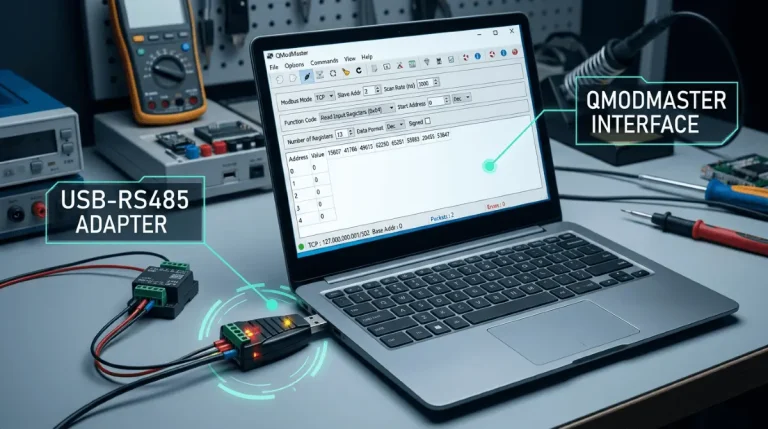
The best way to understand the difference is to see the data in action. QModMaster supports both Modbus RTU and Modbus TCP, allowing you to simulate Master/Client requests for any industrial device.
Common Questions About Modbus Protocols
Quick answers to the most common technical dilemmas in industrial networking.
Q: Is Modbus RTU more reliable than Modbus TCP?
A: It depends on the environment. Modbus RTU (via RS485) is more reliable in environments with extreme electromagnetic interference (EMI) due to its differential signaling. However, Modbus TCP is more reliable in terms of data delivery, as the TCP/IP stack automatically handles packet retransmission and error correction, which serial lines do not.
Q: Can I run Modbus RTU over an Ethernet cable?
A: Yes, but only physically. You can use the twisted pairs inside a Cat5e/Cat6 cable to carry RS485 signals for Modbus RTU. However, this is not Modbus TCP. To truly integrate RTU devices into an Ethernet network, you need a Modbus Gateway to convert the serial frames into TCP packets.
Q: Which is faster: Modbus TCP or RTU?
A: Modbus TCP is significantly faster. While Modbus RTU usually tops out at 115.2 kbps, Modbus TCP operates at standard network speeds (10/100/1000 Mbps). Furthermore, TCP allows for “Parallel Polling,” where a master can talk to multiple slaves at the same time, whereas RTU is strictly “one-by-one.”
Q: What is “Modbus RTU over TCP”?
A: This is a hybrid method (often called Encapsulated Modbus) where a standard Modbus RTU frame (including the CRC) is wrapped inside a TCP packet. It is commonly used by Serial Device Servers to send serial data over a network without stripping the serial formatting. Note that QModMaster supports this mode via its settings.